

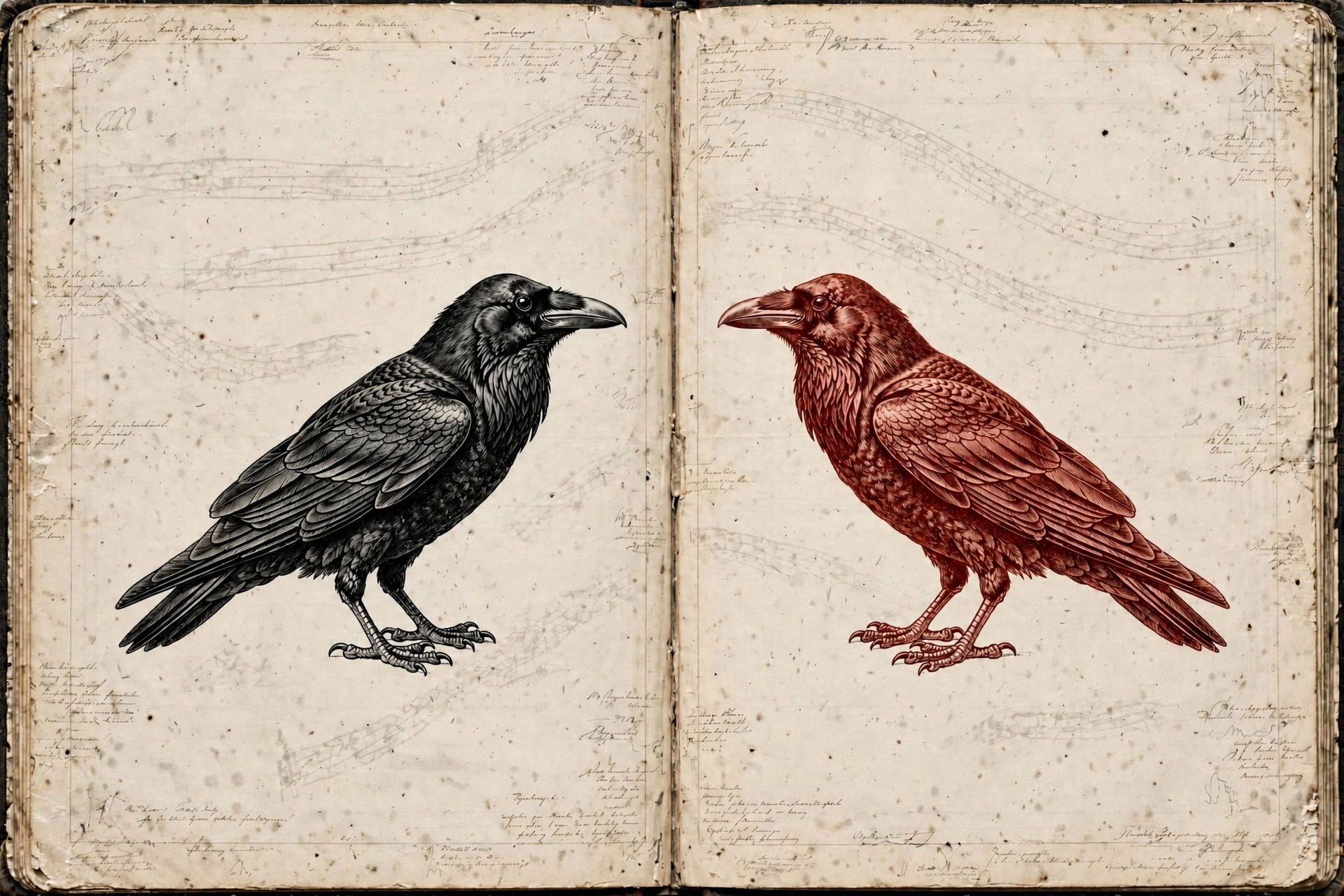
Gilbert knew that Mrs Bell’s youngest son was a resourceful boy. With six older brothers, he had to be. That was why Gilbert chose the scamp to bring him ravens. Intact.
“Worth a shilling, surely?” The boy held out a small, lumpy sack. “It wasn’t easy to catch.”
“Sixpence,” said Gilbert. “A dead bird’s worth sixpence if the head is sound.”
“It’s alive.” The boy prodded the sack. “It was when I found it.”
The sack juddered.
“Very well, put it on the scales.” Gilbert waved vaguely toward a set of battered measuring scales on the table.
The boy set the sack down on the floor. He kept one hand underneath it.
“Caught its foot in the wire,” he said as he slipped his hands into the opening. “I had to cut it loose.”
“Whose wire?”
“Yours, sir.”
Gilbert put on his spectacles. He liked to keep them close at hand. People could do a great deal of mischief while a man was looking for his spectacles.
He opened the bag, expecting a mess of black feathers and blood. Instead, the feathers were a deep, even crimson, right down to the skin. What a curious bird. It was clearly a raven in all aspects other than colour. A loop of wire had cut into the creature’s swollen foot. He bent close enough to see the little double twist he put into all of his snares.
“You’ve been up at the limekiln.”
“Yes, sir.”
“How did you know to bring it here?”
“It told me, sir. As clear as our pond. ‘Take me to Doctor Armstrong.’ It even let me put it back in the sack as we reached your gate.”
Gilbert weighed the bird, then weighed the empty sack. He noted the difference. A swift pen scratch in his book, more words to join the rest of his findings. He never knew what would be important, so Gilbert wrote it all down. He’d paid the boy a sixpence for a black raven the day before.
“A talking raven?” Gilbert’s thin fingers slid beneath his spectacles as he pinched his nose. “Tame, possibly. But wild Corvus corax are not known for their ability to speak.”
“Whatever you say, sir,” the boy said. “Got to be worth a shilling to find out though.”
“My colleague at the club wants to review my findings.” Gilbert thought about Preece, and what he’d make of this. Good, solid, reliable Preece. “No, I don’t think he’d appreciate the fanciful nature of your claims, young man. Without proof, what are we?”
“Nothing, sir,” the boy said with worn-out repetition.
“Precisely!”
Preece’s last letter from London had said that the WASP club would pay handsomely for his study and one bird, alive and in good health. Gilbert had written back to ask what they considered handsome. On that point, Preece had been less than forthcoming, but Gilbert was sure that this creature would be quite the prize.
He tossed a shiny silver shilling at the boy. Queen Victoria’s head spun through the air, and the boy grabbed the coin before it landed. He ran out of the room, all thoughts of birds and wire gone from his mind.
The raven cawed. Gilbert saw that one toe was missing. He pressed at the stump with the tip of his pencil to see whether the bird could feel it. The raven struck at him and broke the lead. Gilbert wrote that down too.
Mrs Bell came in to turn up the gas and halted in the doorway. “He wasn’t lying then?”
“Your boy has found me quite the specimen.” Gilbert couldn’t take his eyes off the red raven.
“I’ve never seen a scarlet one before.” Mrs Bell crept forward as though a sudden movement might cause the bird to explode.
“Scarlet!” Gilbert cheered. Mrs Bell flinched, and the raven looked up, head cocked to one side. “Mrs Bell, that’s perfect. Meet Mr Scarlet.”
Gilbert held his hands out, and the raven alighted upon them. It clicked its beak in excitement and flew over to the worktable.
“Is it a he?”
“Look at the size of him. He’s a fine bird.”
“His foot looks bad.”
The raven had its damaged foot planted on the edge of the scales.
“We shall need to feed him up.”
*
Scarlet’s preferred food was beef, taken from a spoon. After he finished, he gave the bowl two sharp taps with his beak. Gilbert brought him another slice.
That evening, Gilbert heard the same two taps while he was sharpening a pencil. He put down the knife and went to Scarlet’s cage. The bird held the spoon in his mouth. As soon as Gilbert came close, Scarlet let the spoon drop and went back to his perch.
Gilbert scribbled a note in his book.
By Thursday, Scarlet had learnt to wait until Gilbert took off his spectacles before tapping his beak. It took Gilbert most of the day to work out what was going on. Spectacles on, the bird remained silent. Spectacles off, tap, tap, tap.
“Very good,” said Gilbert. He couldn’t help being pleased. He could feel the value of his study increasing moment by moment.
As the clock struck eleven on Friday morning, he set three cups upside down on the worktable. Under one, he put a sliver of beef. He moved the cups about while Scarlet watched, then opened the cage and sat down. Half an hour later, he put Scarlet back behind bars and ate the untouched cold beef himself.
That evening, when he came in from the passage, one cup stood upside down on the floor. He lifted it. Underneath lay the key to the specimen room. Scarlet was on his perch. The cage door was shut.
Gilbert always hung the key on a hook inside his desk. He tried the drawer and found it locked. He examined the key. It was covered in dust. This was the spare. He’d put it on top of the door frame two winters ago and had needed a chair to reach it even then.
He unlocked the specimen room. The air inside smelt of old feathers and the carbolic Mrs Bell used on the floorboards. A black raven lay on a tray by the window, where he’d left her after removing the wire from her throat. He’d meant to skin her on Tuesday. Then Scarlet had come, and he’d let the work go.
A claw clicked on the passage floor behind him.
Scarlet stood in the doorway. He could see the tray from there. Gilbert moved aside to let him pass. The bird stayed where he was, looking up at him.
Gilbert shut the door. When he turned the key, Scarlet gave a low sound he felt on the back of his neck. Gilbert had his pencil out before the sound ended. He stood there with the point against the paper and found he couldn’t think what to put down.
Preece came down from London on the six-forty. He brought a pair of scales in a mahogany box and a letter authorising him to buy the bird. At the head of the page, in small gilt capitals, were the words World Ambassadors for Science and Progress. Sir William Chase had signed at the bottom. The amount was left blank.
“Sir William is content to leave the price to me,” said Preece.
“I’d gathered that.”
Preece spread a length of green baize on the worktable and set out his scales.
“What happens to Scarlet afterwards?” Gilbert asked.
“You’ve named it?”
“Yes. What happens to him?”
“That depends on how well it travels.”
From the cage came two sharp taps. Scarlet had put his weight on the injured foot all day. Now, he was holding it up again.
“Playful fellow.” Preece attempted a laugh that came out as a grunt. “What paint did you use?”
“None.” Gilbert opened the cage and reached in. “Easy, Scarlet. Let me see.”
Scarlet stepped past his hand and out onto the table. He crossed the baize and put a foot on the letter. Gilbert drew it away before the claws could go through. By the time he looked up, the bird was on the floor with something in his bill.
His spectacles. Scarlet had taken them out of his breast pocket while he was bent over the cage. He flew off.
Gilbert followed Scarlet to the specimen room. His spectacles lay folded neatly on the floorboards just under the keyhole. Scarlet waited beside the door. He had both feet on the ground.
“Shall I make it five guineas?” Preece called from the other room.
“No, thank you,” said Gilbert. He was feeling for the spare key. “You can still catch the eight-ten if you go now. Leave the baize, would you?”
“Do you intend me to walk to the station?”
“Mrs Bell will lend you a lantern.”
Gilbert heard Preece slam the lid on his mahogany box. He unlocked the door to the specimen room, and both he and Scarlet slipped inside. Gilbert went straight to the tray, and the fragile raven body.
Scarlet flitted up and perched on the edge of the tray. He ran his bill through the feathers at the black bird’s throat, parting them neatly where the wire had gone in. Then he tucked his head beneath her bill and waited.
Gilbert had seen pairs of ravens touch like that before. The last time, he’d been out at the kiln with a pocket full of wire.
Scarlet took hold of a wing and pulled. The body was too heavy. The tray shifted and caught against Gilbert’s boot.
“Here,” said Gilbert. “Let me.”
He picked up the tray. Scarlet released the wing at once.
*
It was still just about light when Gilbert reached the limekiln. He’d wrapped the black bird in Preece’s baize. Scarlet had followed him up from the house, keeping low over the hedges. Twice, Gilbert lost sight of him, and both times, when he stopped, the bird was on the wall a few yards ahead.
He laid the bundle down near the place where he’d set the snares. Scarlet gave a single low call. From inside the kiln came a thin, cracked answer.
Gilbert put on his spectacles. High in a gap in the brickwork, a young raven stretched its neck and opened its mouth. A second head came up behind it. Scarlet flew to the gap, and the two heads strained towards him.
Gilbert unwrapped the black bird. The feathers on her breast had worn away in a patch. Now, he could see the bare skin. She’d plucked the feathers herself, so the eggs could lie against her.
He remembered hearing the young on Tuesday. He’d thought the noise would make it easier to find the nest when he came back for it.
He bent his head. For a moment, he couldn’t look at Scarlet.
The bird came down to the baize. He rubbed his beak against the dead bird’s and made a soft, rolling sound. From the gap, the young called back.
Gilbert took a step towards the kiln.
“Easy, Scarlet,” said the bird.
It was Gilbert’s own voice.
“Whose wire?” said Scarlet.
Gilbert knew that voice too.
“Mine,” he said. “I set it.”
Scarlet bent over his mate again. He called until his voice roughened. Above them, the young cried and edged to the lip of the brickwork. They came no farther.
Gilbert put his hand beneath the black bird’s breast. It was as cold as the stone.
He took off his coat, lifted her out of the baize, and held her against his shirt. Bare breast to bare skin. The cold of her made him gasp. He wrapped the coat around them both.
“I’m sorry,” he said. His voice broke on the second word. He tried again and managed it.
Scarlet stood close enough for his feathers to brush Gilbert’s wrist. Gilbert’s knees began to hurt on the stones. He kept one hand cupped round her head. He could stay there till dark. He could come back tomorrow with food for the young, and the day after, for as long as Scarlet would let him.
She didn’t warm.
When it was nearly dark, Scarlet flew up to the gap in the brickwork. His red was the last colour on the hillside to go. The young went quiet.
Before he left, Gilbert cut the snares. Every last one.
So good! Loved this.